Advice Center
Tank or tankless at 5,400 feet: choosing a water heater in Aurora
Both kinds of water heater work well in Aurora, but altitude, winter groundwater temperatures and moderately hard water change the math. Here is how to compare them honestly for the way your household uses hot water.
By Mavis Vickery, Advice Center EditorUpdated October 18, 20266 minute read
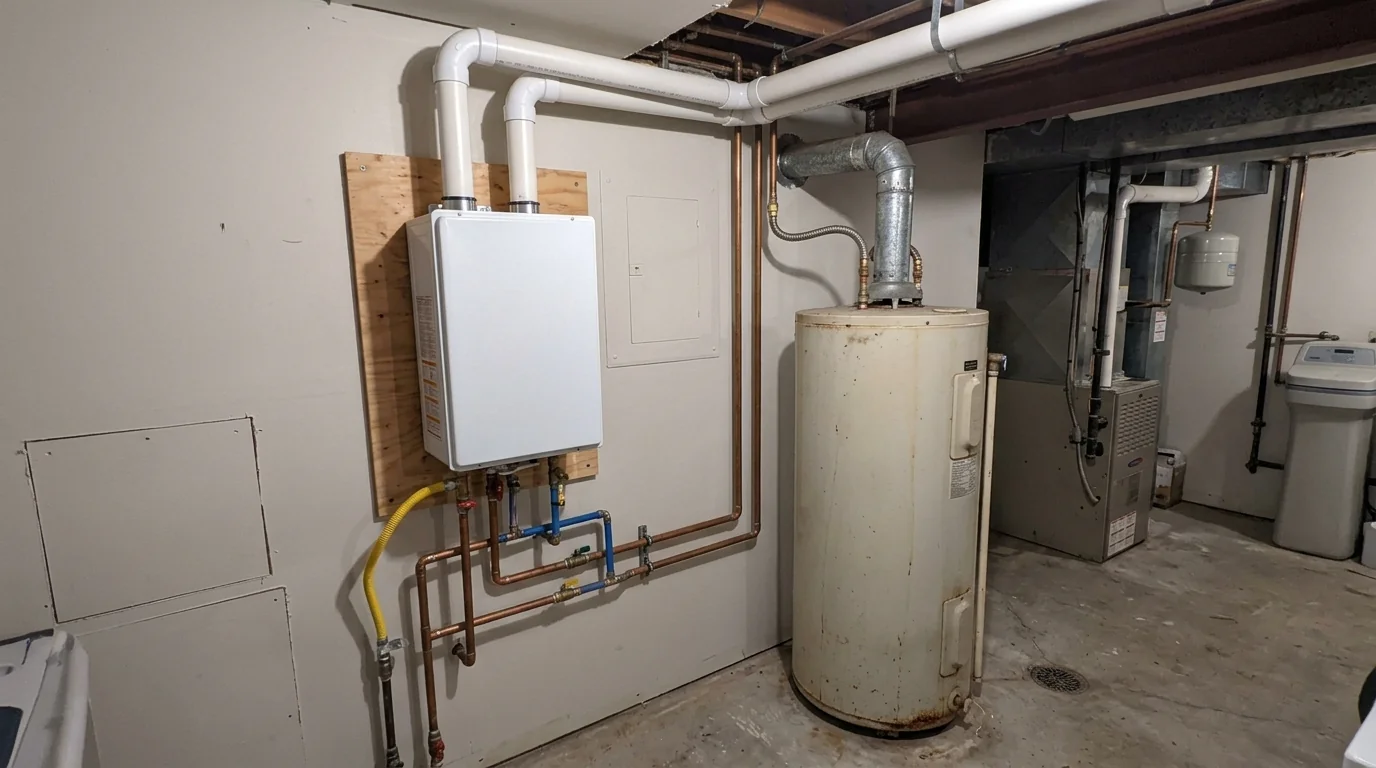
When a water heater fails, most people replace it with whatever was there before. That is often the right call, but it is worth ten minutes of thought first, because the choice between a tank and a tankless unit locks in your costs and your hot water habits for the next decade or more. In Aurora, three local conditions shape that choice: the altitude, the cold water coming into the house in winter, and water that is moderately hard. This guide walks through each one.
How the two kinds of water heater actually work
A tank heater keeps 40, 50 or 75 gallons hot around the clock. When you open a tap, hot water leaves the top of the tank and cold water refills the bottom, where a burner or an electric element heats it back up. You get a large burst of hot water at once, and then a recovery period while the tank reheats.
A tankless heater stores almost nothing. When it senses flow, a powerful burner fires and heats the water as it passes through a heat exchanger. It never runs out, but it can only heat so many gallons per minute. The question is not whether a tankless heater runs out of hot water. It's whether it can keep up when two showers and the dishwasher run at the same time.
What altitude does to gas water heaters
Aurora's posted elevation is 5,471 feet. The air holds less oxygen per cubic foot up here than at sea level, so a gas burner gets less air for the same amount of fuel. Every gas appliance in Aurora, tank or tankless, needs to be set up for high altitude according to the manufacturer's instructions and the code. Skip that step and you can get poor combustion, soot, error codes and carbon monoxide problems.
Manufacturers handle altitude differently. Many derate gas input around 4 percent per 1,000 feet above 2,000 feet as a general guideline, which works out to a noticeable cut at Aurora's elevation. Some tankless models need a setting change or a different part for high altitude, and some publish a lower flow rating above a certain elevation. Before you buy, look up the specific model's high-altitude instructions and its output at your elevation, not the sea level number on the box.
Ask to see the installation manual's high-altitude section for the exact model you're considering. If the unit needs a high-altitude kit or a settings change, make sure it is part of the install price, not an afterthought.
Can a tankless heater keep up in an Aurora winter?
A tankless heater's output depends on how much it has to raise the water temperature. In summer the water arriving from the street is fairly mild. In January it comes in much colder, so the heater has to work harder, and the flow it can deliver at shower temperature drops. A unit that easily handles two showers in July may manage only one and a half in February.
To size a tankless unit, add up the flow of the fixtures you run at the same time during your busiest hour. A typical WaterSense showerhead uses up to 2.0 gallons per minute, a dishwasher about 1 to 2, and a washing machine on warm about 2. Then check the unit's flow chart at a winter temperature rise, adjusted for altitude. Larger families often end up with a higher capacity unit than the showroom suggests, or with two units.
How the costs compare over time
| Factor | Tank (gas) | Tankless (gas) |
|---|---|---|
| Upfront cost | Lower; often a direct swap | Higher, especially when switching from a tank |
| Typical life span | About 8 to 12 years | About 15 to 20 years with regular descaling |
| Hot water supply | Limited by tank size, then a recovery wait | Endless, but limited in gallons per minute |
| Energy use | Standby loss keeps the tank hot all day | Heats only when a tap is open |
| Space | Large footprint on the floor | Mounts on a wall |
| Routine upkeep | Annual flush and anode rod checks | Annual descaling and inlet filter cleaning |
The upfront gap is biggest when you switch from a tank to tankless. The new unit often needs a larger gas line, because it burns far more gas per hour than a tank does while it is running. It also needs new venting, usually PVC run through a wall or the roof, along with a condensate drain for high-efficiency models and an outlet for its controls. Those changes are where most of the extra cost hides. In a newer home that was built with tankless in mind, the swap is much simpler.
Hard water is part of the decision
Aurora Water's 2026 water quality report lists average hardness of 136 mg/L as calcium carbonate, which is roughly 8 grains per gallon and counts as moderately hard. That scale matters more to a tankless heater than to a tank. In a tank, minerals settle to the bottom as sediment. In a tankless unit, they coat the narrow passages of the heat exchanger, cut efficiency and eventually trip error codes.
- Plan to descale a tankless heater about once a year in Aurora, more often if you run hot water heavily.
- Make sure the install includes isolation valves with service ports, so descaling is a quick, routine job.
- A water softener or a scale-reduction filter ahead of the heater extends the time between descalings.
- Tank heaters need flushing to clear sediment and an anode rod check every few years to keep the tank from rusting through.
Which one fits your household?
A tank heater usually makes sense if you want the lowest upfront cost, your current tank sits in a basement with the gas line and venting already in place, and your family's hot water use comes in big bursts, like several showers in a row. A tankless unit makes more sense if you plan to stay in the home for many years, you want the space back, you are tired of running out of hot water, or you are already remodeling and opening walls.
Electric models deserve a separate note. An electric tank heater is simple, has no venting and isn't affected by altitude, which makes it a fair choice where there is no gas line. Whole-house electric tankless units are a different story. They draw a very large amount of current, often more than an older electrical panel can supply, so they rarely make sense as a drop-in replacement in an existing Aurora home without an electrical upgrade.
Both choices need a permit. The City of Aurora requires a permit for water heater replacement, with a plumbing inspection and an electrical inspection where it applies, and we pull that permit as part of the job. Whichever you choose, make sure the installer sets the unit up for altitude, checks the venting and confirms the gas line is sized for the new load.
If you're on the fence, a plumber can look at your gas meter, your venting route and your household's peak demand and tell you what a switch would really involve. Call us and we'll walk through both options and price them side by side, so the decision is yours to make with real numbers in hand.
Questions readers ask about this
Will switching to tankless lower my gas bill in Aurora?
Usually somewhat, because a tankless unit doesn't spend gas keeping a full tank hot all day. How much you save depends on how much hot water you use and how old your current tank is. For many households the savings help over the years but don't repay the higher install cost quickly, so longer life and endless hot water are often the bigger reasons to switch.
Does a tankless heater need a bigger gas line than my old tank did?
Often, yes. A tankless unit burns gas much faster while it runs than a tank does, so the existing line may be too small, especially if the furnace, range and dryer share it. A plumber checks the meter size, the pipe size and the length of the run before recommending a unit, then upsizes the line if the numbers call for it.
Is a hybrid heat pump water heater a good fit for an Aurora basement?
It can be. A heat pump water heater pulls heat from the surrounding air, so it works best in a roomy basement that stays above about 50 degrees, and it cools and dries that space as it runs. It needs room for airflow, a condensate drain and a dedicated electrical circuit. In a small closet or cold garage it is usually a poor match.
Services related to this guide
Tankless Water Heater Installation
Gas tankless water heaters sized for cold winter water, installed with the gas line, venting and condensate drain done properly.
Learn moreWater Heater Installation
New gas and electric tank water heaters sized for your household, set up for altitude, permitted, with the old tank hauled away.
Learn moreWater Softener Installation
Water softeners sized for your household, installed with a bypass, proper drain and an outdoor hose line left unsoftened.
Learn moreRather have a plumber look at it?
Call any time. We answer around the clock.