Advice Center
What pipe is in your Aurora house? A guide by build year
The year your house was built is the best first clue to what runs through its walls. This guide matches Aurora's building eras to the supply and drain pipe you're likely to find, and shows you how to confirm it yourself.
By Mavis Vickery, Advice Center EditorUpdated October 18, 20266 minute read
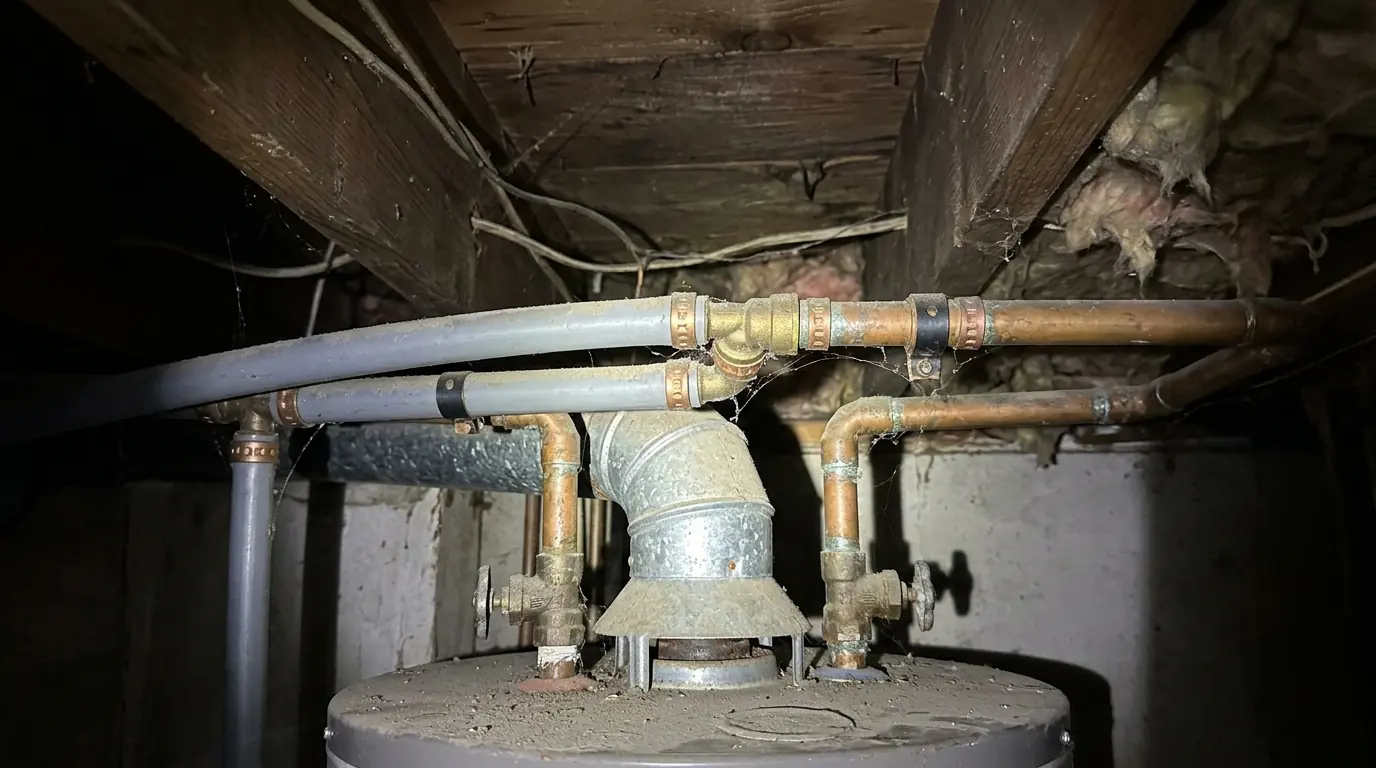
Pipes outlast paint, carpet and kitchens, but they don't last forever, and each material fails in its own way. Knowing what's in your walls tells you what problems to watch for, what an inspector will flag when you sell, and whether a repair makes sense or just delays a bigger job. Aurora grew in waves, and each wave used the materials that were standard at the time. Your build year is a good place to start, and a few minutes with a flashlight will tell you the rest.
The table below sums up the usual pattern by era, but treat it as a guide, not a rule. Many houses have been partly repiped, and a single home can mix three or four materials. Use the table as a starting guess, then check.
| Build era | Where it's common | Likely supply pipe | Likely drain and sewer pipe |
|---|---|---|---|
| 1940s and 1950s | Original Aurora near Colfax, northwest Aurora | Galvanized steel | Cast iron inside, clay sewer lateral |
| 1960s and 1970s | Central Aurora ranches and split-levels | Copper | Cast iron, aging laterals |
| About 1978 to 1995 | Much of southeast Aurora | Copper or polybutylene | ABS or PVC plastic |
| 2000s to today | Far southeast and northeast Aurora | PEX | PVC or ABS plastic |
Galvanized steel: the 1940s and 1950s homes
Galvanized pipe is steel coated in zinc. It is dull gray, joined with threaded fittings, and a magnet sticks to it firmly. The zinc wears away over the decades, and the steel underneath rusts from the inside, narrowing the pipe a little at a time. Homes with original galvanized lines often have weak pressure at upstairs fixtures, rusty water after the water sits overnight, and leaks at threaded joints where the pipe wall is thinnest.
There is also a service line question. Aurora Water has a lead service line program for homes built in 1960 or earlier, especially in Original Aurora, because those homes may have lead or galvanized service lines running in from the street. The city keeps a lead status map you can check, and it may replace qualifying lines at no cost. If your house falls in that range, look up your address before you plan any work on the water line.
Copper: the long middle stretch
Copper became the standard for supply lines in the 1960s and stayed common for decades. It is reddish brown, or green where it has oxidized, and joined with soldered fittings. A magnet won't stick. Copper usually lasts a long time, but it can develop pinhole leaks after many years, especially where water velocity is high or where the pipe touches concrete. Hard water, like Aurora's moderately hard supply, can leave scale inside, though it rarely blocks a copper line the way rust blocks galvanized pipe.
If your copper is original to a 1960s or 1970s home, look closely at the joints and the spots where pipe passes through framing or masonry. Green crust at a fitting often marks a slow weep that is worth fixing before it grows.
Polybutylene: the one to know about
Polybutylene is a flexible plastic supply pipe that was installed nationwide in homes built roughly 1978 to 1995, and it is prone to failure, especially at its fittings. It is usually gray, sometimes blue or black, with crimp rings or plastic fittings at the joints. It may be stamped PB2110. Polybutylene tends to fail without warning, and when it goes, it often fails while nobody is home to catch it.
- Check where the main enters the house and at the water heater, where pipe is usually exposed.
- Look under sinks and behind toilets. Sometimes polybutylene is hidden behind short copper stubs coming out of the wall, so check both.
- Polybutylene is a common item on a home inspection report, and some insurers and buyers treat it as a reason to negotiate.
- Full replacement is the usual answer, since patching one failed fitting doesn't change the rest of the system.
Don't confuse gray polybutylene with PEX. PEX is usually red, blue or white and printed with the letters PEX along its length. If the pipe is gray and has no PEX stamp, treat it as polybutylene until someone confirms otherwise.
PEX and plastic drains: the newer neighborhoods
Homes built from the 2000s onward almost always use PEX for supply. It is flexible, color coded red for hot and blue for cold in many installs, and connected with crimp, clamp or expansion fittings. It resists scale, handles freezing better than metal pipe and is the usual material for repiping older homes as well. PEX should be kept out of direct sunlight, and its fittings are the parts to watch over time.
Drains in newer homes are black ABS or white PVC plastic. Both last a very long time inside the house. Outside, the sewer lateral is usually PVC, which handles Front Range clay better than older clay pipe but can still sag if it wasn't bedded well.
Cast iron drains in older homes
Homes built from the 1940s through the 1970s usually have cast iron drain pipe inside, often with a clay or cast iron lateral running out to the street. Cast iron is heavy, black or dark brown, and quiet, which is one thing people like about it. Its weakness is the inside. Over many decades the pipe corrodes from within, scale builds up along the bottom, and the wall thins until cracks appear, usually along the lower half where waste flows.
Signs of tired cast iron include slow drains that come back soon after clearing, rust stains or damp spots on the outside of a horizontal run, and a sewer smell near the stack. In a finished basement, those horizontal runs are often hidden in the ceiling or under the slab, so a camera inspection is the easiest way to see their condition. Replacing a bad section with PVC is common, and it's often done when a bathroom or basement is remodeled anyway.
If you're buying or selling, pipe material matters on paper too. Inspection reports routinely call out galvanized supply, polybutylene and aging cast iron, and buyers ask about them. Knowing what you have, and having any repair records ready, makes those conversations a lot shorter.
How to check your own pipes in ten minutes
- Find the main water shutoff, usually in the basement or garage on the street side of the house. Note the pipe material coming up through the floor or wall.
- Look at the pipes on top of the water heater. These are almost always exposed, and you'll often see a transition from one material to another here.
- Check under every sink and behind each toilet for the material coming out of the wall.
- In an unfinished basement, follow the pipes along the ceiling joists and look for spots where materials change.
- Try a magnet on any gray pipe. If it sticks, it's galvanized steel. If it doesn't, it may be polybutylene, lead or another plastic.
- Find the main drain stack and the cleanout. Heavy black metal is cast iron. Black or white plastic is ABS or PVC.
A soft, dull gray pipe that shines silver when you scratch it gently with a key, and that a magnet won't grab, could be lead. That is most likely near the meter in homes built before about 1960. Don't sand or cut it, and check the city's lead status map.
If you find polybutylene, aging galvanized pipe or a mix you can't identify, have a plumber take a look before you make plans. Call us and we'll identify every material in the house, point out the parts that are near the end, and give you a straight answer on whether spot repairs or a repipe makes more sense.
Questions readers ask about this
Can a house have galvanized and copper pipe mixed together?
Yes, and it's common in older Aurora homes that were partly repiped over the years. The trouble spot is where the two metals meet. Joining them directly without a proper dielectric fitting speeds corrosion at that joint, and those connections often leak first. A plumber can replace the transition fittings or remove the remaining galvanized sections.
How do I tell lead pipe from galvanized pipe?
Galvanized steel is hard, threaded at the joints, and a magnet sticks to it firmly. Lead is soft, dull gray and shows a shiny silver color when you scratch it lightly with a key, and a magnet won't stick. Lead usually appears on the service line near where it enters the house, mainly in homes built before about 1960.
Does home insurance cover leaks from polybutylene pipe?
It depends on the policy. Some insurers cover sudden water damage regardless of pipe type, some limit coverage, and some won't write a new policy on a home with known polybutylene. Ask your agent directly and get the answer in writing. If you're buying a home built between roughly 1978 and 1995, ask about the pipe before closing.
Services related to this guide
Whole-House Repiping
Replace failing galvanized, polybutylene or pinholed copper supply pipe with new PEX or copper throughout the whole house.
Learn moreMain Water Line Repair & Replacement
Repair or replace the buried water service line between your meter and house when it leaks, breaks or loses pressure.
Learn moreWhole-Home Plumbing Inspection
A top-to-bottom plumbing checkup for buyers, sellers and owners: pipes, drains, water heater, valves, pressure and fixtures.
Learn moreRather have a plumber look at it?
Call any time. We answer around the clock.