Advice Center
Backflow testing in Aurora: what property owners need to know
If your property has a sprinkler system, a fire line or certain commercial equipment, there's a backflow assembly keeping that water out of the drinking supply. Here is what it does, how testing works and how to keep it healthy.
By Mavis Vickery, Advice Center EditorUpdated October 18, 20266 minute read
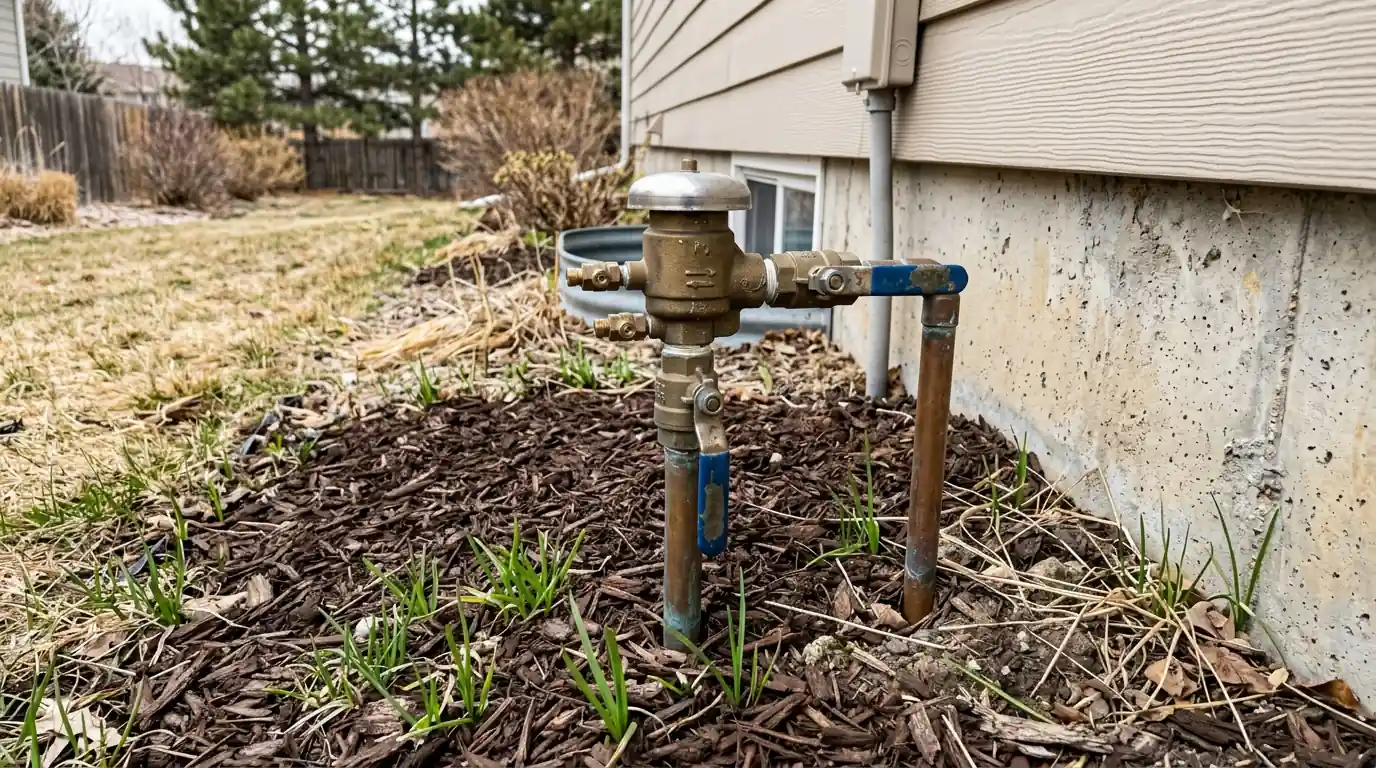
Most homeowners only think about their backflow assembly when the testing notice arrives or when the brass fitting by the foundation splits in a freeze. That device does an important job, though. It keeps water that has sat in sprinkler lines, fire sprinkler piping or commercial equipment from flowing backward into the pipes that supply drinking water. Here is what it does, what Aurora expects of property owners, and how to keep it working.
What is backflow, and why does it matter?
Water in your pipes normally moves one way, from the main toward your fixtures. Backflow is when it reverses. There are two ways it happens. Back siphonage occurs when pressure in the main drops suddenly, for example during a main break or when a fire hydrant opens nearby, and the low pressure pulls water backward out of the property's pipes. Back pressure occurs when pressure on the property side rises above the supply pressure, as can happen with pumps or boilers.
Either way, water that should never reach a glass can be pulled into the system. Sprinkler lines can hold standing water mixed with fertilizer, pesticide and soil. Fire sprinkler systems hold stagnant water, sometimes with antifreeze. That is why codes require a mechanical barrier wherever those systems tie into drinking water.
Properties in Aurora use three main types of assembly, and the one you have depends on the hazard it guards against. Knowing which one sits beside your foundation or in your vault helps you read a test report and order the right parts.
| Assembly | Where you see it | How it works |
|---|---|---|
| Pressure vacuum breaker (PVB) | Most residential sprinkler systems, above ground near the house | A spring-loaded check and an air inlet that opens to break a siphon |
| Double check valve assembly | Some sprinkler systems and fire lines, often in a vault | Two check valves in a row, each able to close on its own |
| Reduced pressure zone assembly (RPZ) | Commercial sites and higher hazard connections | Two checks plus a relief valve that dumps water if either check fails |
All three have test cocks, the small valves on the side of the body, and two shutoff valves, one on each end. Those parts are what the tester uses.
What Aurora requires
Aurora City Code requires backflow prevention assemblies to be tested at least annually by a cross-connection control technician who holds the credential the city recognizes, and the results go to Aurora Water. A property owner can't run the test themselves, and a test that never reaches Aurora Water doesn't count. Assemblies that fail have to be repaired or replaced, at the owner's expense, and then tested again.
Aurora Water requires backflow assemblies on sprinkler systems to be tested, and spring start-up is when most owners schedule it, since the system is being turned on anyway. New lawn sprinkler systems in Aurora need a permit, so a new install should come with a properly placed assembly from the start. If you receive a notice from Aurora Water, read it carefully and follow the date it gives for your property.
Keep a simple file with your assembly's make, model, size and serial number, plus a copy of each year's test result. If a tester ever reports a failure, those details make ordering the right repair kit quick.
What happens during a test?
A test takes about 20 to 30 minutes for a typical residential assembly, and the water is off to the sprinklers for most of it.
- The tester closes the downstream shutoff valve and connects a differential pressure gauge to the test cocks.
- Each check valve is tested to confirm it holds a set minimum pressure difference and closes tightly.
- On a pressure vacuum breaker, the air inlet is tested to confirm it opens at the right pressure.
- On an RPZ, the relief valve is tested to confirm it opens when it should.
- The tester records the readings, reopens the valves and sends the results to Aurora Water.
- If any part fails, you get a list of what needs repair, usually a rubber seat, a spring or an O-ring kit.
Most failures come from debris lodged in a check valve, worn rubber parts or freeze damage. A rebuild kit often fixes the assembly without replacing the whole body.
Signs your assembly needs attention before test day
You don't need a gauge to notice that something is off. A healthy assembly is quiet and dry while the sprinklers run. Walk past yours a few times during the first weeks of the season and look for these clues.
- Water dripping or spraying from the top of a pressure vacuum breaker while the system is pressurized, which often points to a worn air inlet seal or debris under the check.
- A steady trickle from the relief port of an RPZ, which means one of its checks isn't holding.
- Green or white crust on the body or around the bonnet, a sign of a slow leak that has been evaporating for a while.
- Weak pressure at every sprinkler zone even though household fixtures work normally, which can mean a shutoff valve is only partly open or the assembly is clogged.
- Visible cracks, a bulged bonnet or a shutoff handle that spins without turning the valve.
Commercial property owners carry the same duty on a larger scale. Restaurants, offices, apartment buildings and shops may have several assemblies on irrigation, fire lines, boilers, carbonated drink machines and other equipment. Each assembly gets its own test and its own result. A simple log of locations and serial numbers keeps any of them from being missed.
Protect the assembly from freezing
Residential pressure vacuum breakers sit above ground, usually beside the foundation, and they are one of the most common freeze casualties in Aurora. The body is cast brass, and when water trapped inside freezes, it can crack the body or pop the bonnet. A split assembly is often found only in spring, when the sprinkler system is turned on and water sprays across the side of the house.
- Before the first hard freeze, close the sprinkler system's indoor shutoff and drain the line.
- Open the test cocks and set the shutoff handles at a half-open angle so trapped water can escape.
- Have the system blown out with compressed air to clear water from the zones and lines.
- Wrap the assembly with an insulated cover after it's drained. A cover alone won't protect an assembly that still holds water.
- In spring, open the shutoffs slowly and close the test cocks before pressurizing the line.
When should a plumber get involved?
A plumber is the right call when an assembly is cracked, leaking from the body or bonnet, missing, installed too low or in the wrong spot, or failing its test year after year. Moving an assembly, replacing a split one or adding the right device for a new irrigation or boiler connection is plumbing work, and it needs to be followed by a test before the system goes back into service.
If your backflow assembly split in the cold, leaks when the sprinklers run or keeps failing its test, call us before the watering season gets going. We'll repair or replace it and get it ready for testing so the paperwork can reach Aurora Water on time.
Questions readers ask about this
Do I need a backflow test if I never use my sprinklers?
If the sprinkler system is still connected to your water supply, the assembly is still protecting the drinking water and testing generally still applies. Not running the zones doesn't remove the connection. If you have no plans to use the system, ask Aurora Water about having it properly disconnected and capped, which can take the assembly off your list.
Why is water spraying out of my backflow preventer in the spring?
The most common cause is freeze damage: water left in the assembly over winter froze and cracked the brass body or pushed the bonnet loose. It can also be a test cock left open or a worn air inlet seal. Shut off the sprinkler supply valve right away, then have the assembly inspected and repaired or replaced before the system goes back on.
Can a backflow assembly be moved closer to the house or out of the way?
Usually, yes, as long as the new location meets code for height and access and stays where it can be tested and drained easily. Moving it means changing the sprinkler supply piping, so it's plumbing work and should be followed by a fresh test. Relocating an assembly into a garage or basement may require a different type of device.
Services related to this guide
Backflow Testing & Repair
Annual backflow assembly testing, spring sprinkler start-up checks and repairs for freeze-cracked or failing backflow preventers.
Learn morePipe Freeze Protection
Pipe insulation, heat cable, rerouting and winter shutdown plans that keep water lines from freezing in deep cold.
Learn moreOutdoor Faucet & Sillcock Repair
Leaking hose bibs and freeze-damaged sillcocks repaired or replaced with frost-free valves built for Colorado winters.
Learn moreRather have a plumber look at it?
Call any time. We answer around the clock.