Advice Center
How to find and shut off the main water valve in an Aurora home
When a pipe splits, the first minute decides how much water ends up on the floor. Here is where Aurora homes usually hide the main valve, how to close each type, and how to keep it ready for the day you need it.
By Mavis Vickery, Advice Center EditorUpdated October 18, 20266 minute read
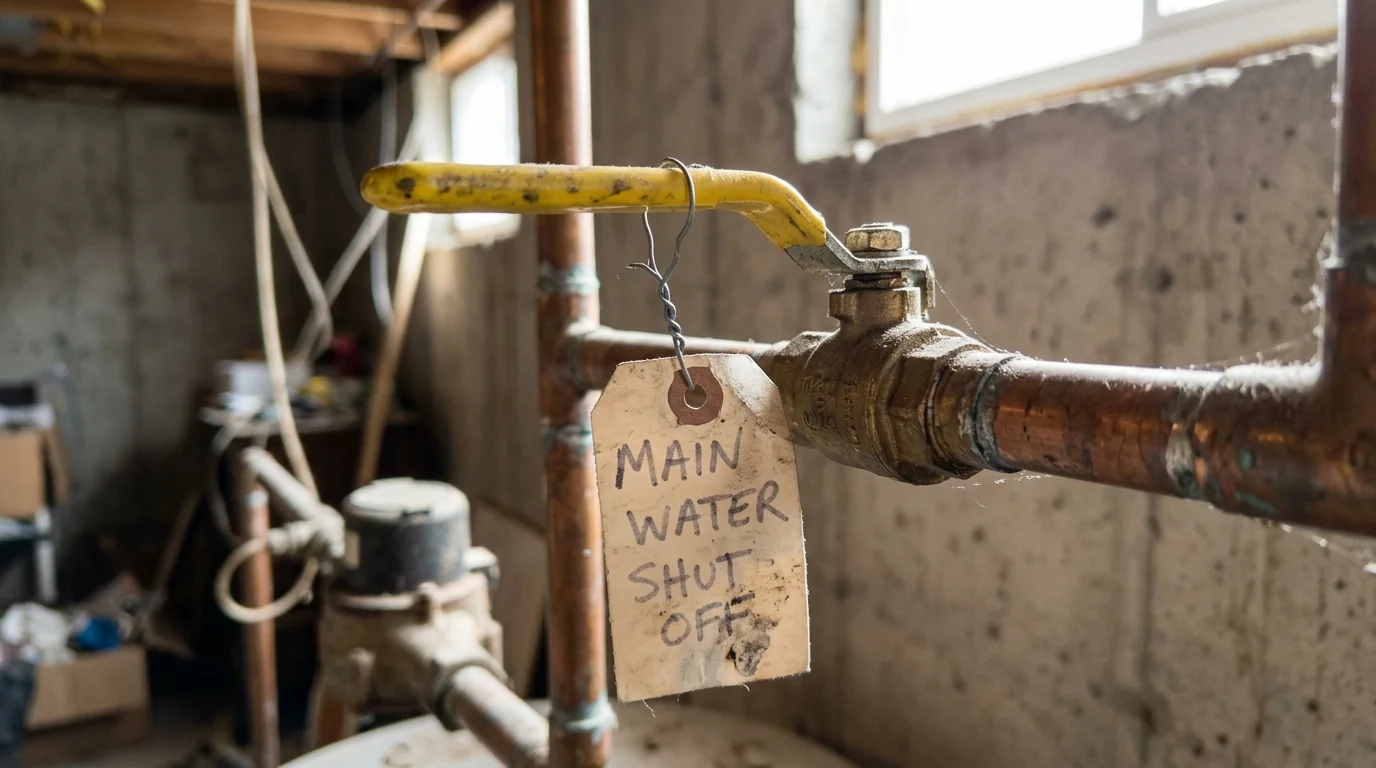
Every homeowner should be able to stop the water to the whole house in under a minute. When a supply line bursts behind the washer or a pipe splits in a cold garage wall, the gallons add up fast, and the damage grows with every minute you spend searching. The good news is that most Aurora homes put the main valve in one of a few predictable places. Find yours today, test it and label it, and you'll be ready when it matters.
Where is the main shutoff likely to be in your house?
The main valve sits where the water service line enters the house. In Aurora that line comes from the meter, runs underground below the frost line, and comes up through the foundation or the slab. Aurora's building code sets the frost line at 36 inches, so the pipe stays deep until it reaches the house and then turns up into a wall or floor. Look for a pipe about the thickness of your thumb or a little larger, usually copper in older homes and copper or PEX in newer ones.
- Basement homes: check the utility room first, on the wall that faces the street. The valve is often within a few feet of the floor drain, the water heater or the furnace, and sometimes behind a removable panel in a finished wall.
- Homes without basements: look in the garage on the wall closest to the street, inside a utility closet near the water heater, or behind an access panel low on an interior wall.
- Crawlspace homes: the valve can sit just inside the crawlspace hatch, which is a poor spot in an emergency. If yours is there, note it and think about adding a second valve somewhere easier to reach.
- Townhomes and condos: there may be a valve for your unit in a mechanical closet, near the water heater, or in a shared utility room. Ask your HOA where it is before you need it.
If you still can't find it, follow the cold water pipe backward from the top of the water heater. That line almost always leads toward the point where the main enters, and the valve tends to sit within a few feet of the entry. A pressure reducing valve, a bell-shaped brass fitting on the main line, is another landmark. The shutoff is usually just before it, on the street side.
Which type of valve do you have, and how does it close?
Three styles of valve show up on Aurora main lines. Their handles look different, and each one closes a little differently.
| Valve type | What it looks like | How to close it |
|---|---|---|
| Ball valve | A straight lever handle, often yellow, red or blue | Turn the lever a quarter turn so it sits crosswise to the pipe |
| Gate valve | A round wheel handle, common in older homes | Turn clockwise several full turns until it stops, without forcing it |
| Globe or stop valve | A smaller round or oval handle on a domed body | Turn clockwise until it is snug |
Ball valves are the easiest. When the lever runs in line with the pipe, water flows. When it sits across the pipe, the water is off. Gate valves in homes built from the 1940s through the 1970s are often original, and their stems and internal gates corrode with age. They can stick open, snap off in your hand or close only part of the way. Turn them gently. If a gate valve won't move with firm hand pressure, stop before you break the stem, and move on to the outside options described below.
How to shut off the water in an emergency
- Go straight to the main valve and close it fully. Don't stop to mop first, because the water keeps coming until the valve is shut.
- If water is reaching outlets, light fixtures or the breaker panel, stay out of the wet area. Switch off power at the panel only if you can reach it from a dry spot.
- Open a faucet on the lowest level of the house, such as a basement laundry sink or a hose bib. This drains pressure out of the pipes and slows whatever is still leaking.
- Turn off the water heater. Set a gas unit's control to pilot or off, or switch off the breaker for an electric unit, so it doesn't heat a tank that may be draining.
- Take photos of the leak and the damage before cleanup starts. They help with an insurance claim later.
- Move rugs, boxes and furniture out of the water, and start drying with towels and fans.
Hang a bright tag on the main valve that says MAIN WATER SHUTOFF, and walk everyone in the house to it, including teenagers and anyone who house-sits for you. In an emergency, the person standing in the water is not always the person who knows where the valve is.
What if the main won't close, or the leak is before it?
Sometimes the main valve fails, or the leak is on the short piece of pipe between the floor and the valve. Then the next place to stop the water is outside, at the meter. Many Front Range homes have a meter in a buried pit near the street or sidewalk, with a valve that takes a long key to reach. That equipment belongs to the water system, so Aurora Water is the right first call if you can't stop a leak from inside. Their crews can shut off service at the meter, and plumbers carry the same kind of key for emergencies.
It helps to know where responsibility changes hands. Aurora Water says residents own the service line from the home to the meter, and the city owns the line from the meter to the main. A leak in the yard between the meter and the house is yours to repair, while a leak beyond the meter belongs to the city. Water bubbling up in the lawn in winter, or a soggy patch that never dries out, is worth reporting quickly either way.
Test your valve twice a year so it works when you need it
A valve that hasn't moved in ten years is the one most likely to fail on the worst night. Testing it takes five minutes. Close the main, then open a faucet upstairs and watch the flow. It should taper to a trickle and stop within a minute or so. If water keeps running, the valve isn't sealing. Open the main again slowly so you don't send a pressure surge through the pipes, then check the stem for drips once it is fully open.
- Close and reopen the valve twice a year. Spring and fall work well, since they bracket freeze season.
- If a gate valve weeps at the stem after you turn it, snug the packing nut just under the handle by about an eighth of a turn.
- Keep the area clear. A finished basement with boxes stacked in front of the access panel turns a ten second job into a five minute search.
- Learn the smaller shutoffs too: under each sink, behind each toilet, on the washer hoses and on the cold line into the water heater. Closing one of those lets the rest of the house keep running while you deal with a single fixture.
When you leave for a trip in winter, close the main and leave the heat on. A failed washer hose or a frozen pipe can't flood the house if no water is flowing into it. Before you go, open a faucet briefly to confirm the valve actually stopped the flow.
When is it time to replace the main shutoff?
Replace the valve if it won't close all the way, if it leaks at the stem every time you use it, if the handle is cracked or the stem is bent, or if it is a gate valve so old you are afraid to touch it. A full port ball valve is the usual upgrade. It closes with a quarter turn, seals reliably and lets full flow through when open. If your home has a pressure reducing valve, it is also a good time to make sure there is a shutoff on each side of it, so that part can be serviced later without digging for the meter.
If your main valve is stuck, leaking or hidden somewhere you can't reach in a hurry, have a plumber replace it before the next cold snap rather than during one. Give us a call and we'll handle it as a planned job, which is a lot calmer than doing it with water on the floor.
Questions readers ask about this
Is it safe to leave the water heater on while the main water is off?
For a short shutoff, yes. The tank stays full because hot water can't leave unless cold water comes in to replace it. If the water will be off for hours, or you plan to drain the pipes, set a gas heater to pilot or switch off the breaker for an electric one so it never heats a partly empty tank.
Can I open the meter pit and shut the water off there myself?
It's best not to. The meter, the pit and the valve inside belong to the water system, and an old valve can break if it's forced. Pit lids are heavy, and the pit can hold water or ice. Call Aurora Water to shut service at the meter, or have a plumber with the proper key do it for you.
How long do the pipes keep draining after I close the main valve?
Usually a minute or two. Opening a faucet on the lowest level speeds it up and pulls water away from the leak. A small amount may keep dribbling from the lowest fixtures for a while as pipes on upper floors empty. A steady stream that doesn't slow down means the main valve isn't sealing.
Services related to this guide
Shut-Off Valve Replacement
Swap seized gate valves and leaky fixture stops for quarter-turn ball valves you can close fast in an emergency.
Learn moreEmergency Plumber
Burst pipes, sewage backups, overflowing toilets and no water at night, handled 24/7 across Aurora and the east metro.
Learn moreBurst Pipe Repair
Split and burst water pipes stopped, cut out and repaired fast, day or night, with damage kept to a minimum.
Learn moreRather have a plumber look at it?
Call any time. We answer around the clock.