Advice Center
Is Aurora's water hard enough to need a softener?
Aurora Water's own report puts average hardness at about 8 grains per gallon. That's moderately hard: not extreme, but enough to show up on glass, faucets and water heaters. Here is how to decide whether a softener is worth it.
By Mavis Vickery, Advice Center EditorUpdated October 18, 20266 minute read
If you've noticed white spots on your shower glass or crust around your faucet aerators, you've met Aurora's hard water. The question most homeowners ask next is whether it's bad enough to justify a softener. The honest answer is that it depends on your house, your appliances and how much the scale bothers you. This guide gives you the numbers, explains what they mean for your plumbing, and helps you decide.
How hard is Aurora's water, really?
Aurora Water's 2026 water quality report lists average hardness of 136 mg/L, measured as calcium carbonate. That works out to roughly 8 grains per gallon, which falls in the moderately hard range. Hardness also varies through the year, so some days the water at your tap is softer than the average and some days harder.
The variation makes sense when you look at where the water comes from. Aurora draws supplies from the South Platte, Arkansas and Colorado river basins, plus the Prairie Waters system, which recaptures South Platte water through riverbank filtration before treatment. Different sources carry different mineral loads, and the blend changes with the seasons and with demand.
| Hardness level | Grains per gallon | Milligrams per liter | What you tend to notice |
|---|---|---|---|
| Soft | Under 1 | Under 17 | Very little scale |
| Slightly hard | 1 to 3.5 | 17 to 60 | Faint spotting over time |
| Moderately hard | 3.5 to 7 | 60 to 120 | Spots on glass, slow scale buildup |
| Hard | 7 to 10.5 | 120 to 180 | Regular crust on fixtures, sediment in heaters |
| Very hard | Over 10.5 | Over 180 | Heavy scale and frequent appliance trouble |
Charts like this use slightly different cutoffs depending on the source. At about 8 grains, Aurora sits at the line between moderately hard and hard, which is why the effects are noticeable but rarely severe.
What hardness does inside your plumbing
Hard water carries dissolved calcium and magnesium. Those minerals stay dissolved in cold water but come out of solution when water is heated or evaporates. That's why scale shows up first where heat or drying is involved.
- Tank water heaters collect sediment at the bottom, which causes popping noises, slower recovery and extra wear on the tank.
- Tankless water heaters build scale inside the heat exchanger, which cuts efficiency and triggers error codes until the unit is descaled.
- Faucet aerators and showerheads clog with mineral grit, and flow drops.
- Dishwashers and washing machines develop scale on heating elements and valves, and glasses come out cloudy.
- Glass shower doors, tile and chrome fixtures get white spots that take scrubbing to remove.
- Soap and shampoo lather less, so many people use more of them.
What hardness generally does not do is make water unsafe to drink. Calcium and magnesium are common minerals, and the issue is mostly about wear and cleaning, not health.
Simple ways to manage scale without a softener
Plenty of Aurora households live with moderately hard water and never install a softener. If that's your plan, a few habits keep scale from causing real damage.
- Flush your tank water heater once a year to clear sediment before it hardens into a layer on the bottom.
- Have the anode rod checked every few years, since hard water and heat speed up tank wear.
- Descale a tankless heater about once a year with the service valves and a small pump made for the job.
- Soak showerheads and aerators in white vinegar for an hour or two when flow starts to drop.
- Keep the water heater at about 120 degrees. Hotter settings drive more minerals out of the water and build scale faster.
- Use a rinse aid in the dishwasher and run its cleaning cycle every month or two.
These steps cost very little, and they handle most of what moderately hard water does to a house. A softener becomes the better answer when you're doing them constantly and still fighting crust, or when you want to protect an expensive tankless unit.
Do you need a softener? A quick self-check
Run through these questions. The more you answer yes, the more a softener is likely to pay off.
- Do you have a tankless water heater, or are you planning to install one?
- Do you descale or replace showerheads and aerators more than once a year?
- Has your tank water heater gotten noisy, or have you had to flush it often to keep it quiet?
- Do spots and crust on glass and fixtures bother you enough to clean them weekly?
- Do you plan to stay in the house for several more years?
- Is there room near the main water line for a softener and its brine tank, plus a drain and an outlet?
If you answered yes to the first question alone, a softener or a scale-reduction system is worth serious thought. A tankless heater is the appliance that suffers most from scale, and protecting it extends the time between descalings.
Test your own tap before you buy anything. Inexpensive hardness test strips from a hardware store give you a reading in a minute. Test in a couple of different seasons, since Aurora's hardness changes through the year.
Softener, conditioner or filter: what's the difference?
A traditional salt-based softener uses ion exchange. Water passes through resin beads that trade the calcium and magnesium for sodium. The resin is recharged with salt from a brine tank, and that recharge cycle sends a small amount of brine to the drain. It truly removes hardness, so spots and scale largely disappear.
A salt-free conditioner, often called template assisted crystallization, changes the minerals so they are less likely to stick to surfaces. It doesn't remove them, so water still tests hard, but scale buildup in heaters and fixtures is reduced. It uses no salt and sends nothing to the drain. A whole-house filter is a separate tool. It removes sediment, chlorine taste or odor depending on the cartridge, but most filters do little about hardness on their own.
Many homes pair a sediment or carbon filter with a softener or conditioner. If you only want to protect a tankless heater, a scale-reduction cartridge installed just ahead of the heater is another option.
Practical points before you install
- Bypass the outdoor spigots so you aren't softening water that goes on the lawn.
- Size the softener to your household's daily use and your measured hardness, not the biggest unit available.
- Make sure there is a proper drain with an air gap for the backwash line.
- Plan for regular salt refills and periodic service, or ask about salt-free options if hauling salt is a concern.
- Some people prefer to leave a kitchen cold tap unsoftened for drinking and cooking.
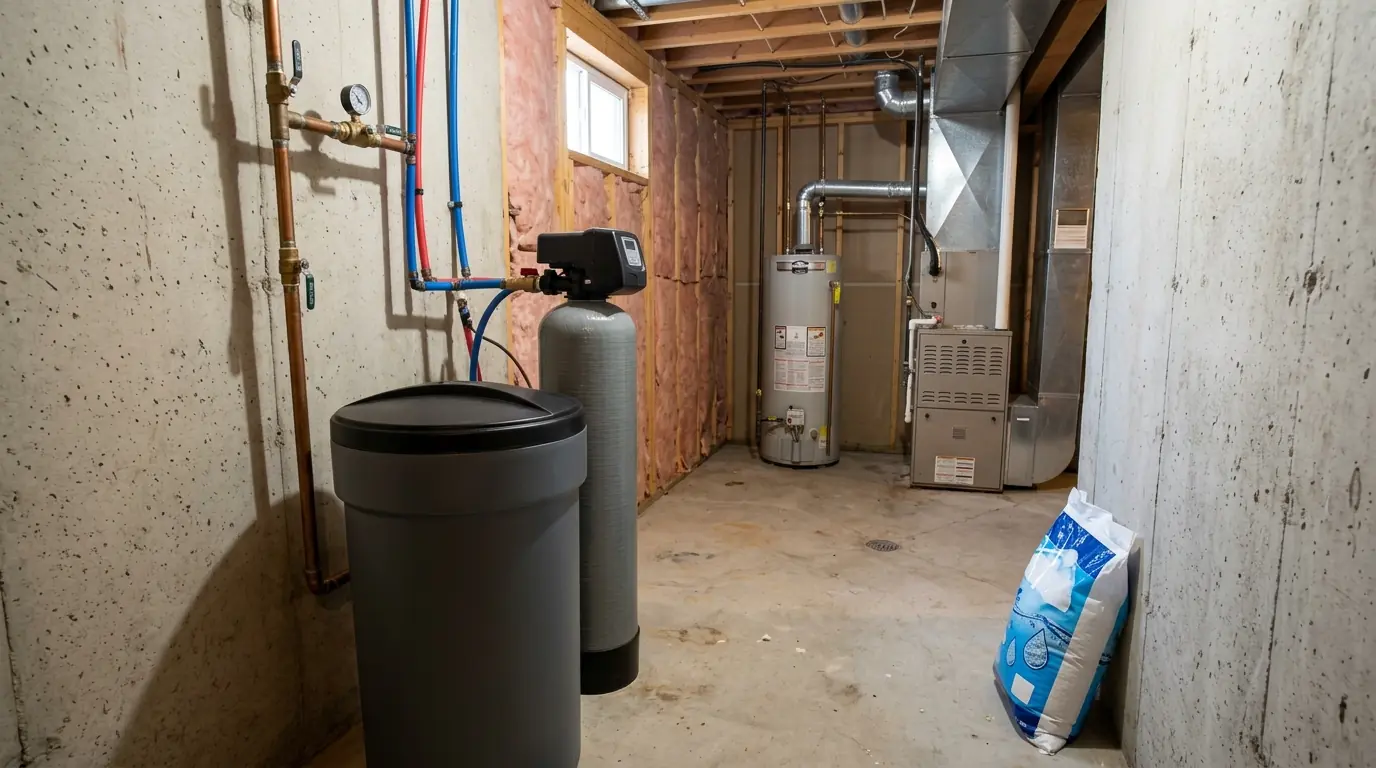
Placement matters as much as the unit. The softener belongs on the main line after the shutoff and any pressure reducing valve, and before the water heater, so both hot and cold water inside the house are treated. In many Aurora basements that spot is easy to reach. In homes where the main enters a cramped garage closet, it can take some rerouting.
If you're tired of scale on your fixtures, your water heater is getting loud, or you're putting in a tankless unit, call us. We'll test your water, look at your plumbing and space, and recommend the simplest setup that solves the problem you actually have.
Questions readers ask about this
Does softened water taste salty?
Most people don't notice any taste. A softener adds sodium in proportion to the hardness it removes, and at about 8 grains per gallon the amount is small. People on a low sodium diet should check with their doctor, though. Some homeowners leave the kitchen cold tap unsoftened for drinking, or use a potassium chloride softener salt instead.
Will a water softener stop my faucets from spotting completely?
It removes most of the minerals that cause spots, so you'll see far less crust on glass, chrome and tile. You may still see faint marks where water evaporates, because softened water still carries some dissolved solids. A squeegee on the shower glass after use and wiping the faucet handles occasionally take care of what's left.
Does hardness explain the white flakes in my Aurora tap water?
Often, yes. White flakes or grit in an aerator are usually mineral scale or sediment from the water heater. If they appear mostly in hot water, the tank may need flushing, or its dip tube may be breaking down. Clean the aerator, flush the heater, and call a plumber if the flakes keep coming back.
Services related to this guide
Water Softener Installation
Water softeners sized for your household, installed with a bypass, proper drain and an outdoor hose line left unsoftened.
Learn moreWhole-House Water Filtration
Whole-house carbon, sediment and combination filters installed at the main line, plus under-sink reverse osmosis for drinking water.
Learn moreTankless Water Heater Repair
Error codes, ignition failures, temperature swings and scale buildup diagnosed and repaired on gas and electric tankless units.
Learn moreRather have a plumber look at it?
Call any time. We answer around the clock.